Cockatoo Dwarf Cichlid (Apistogramma cacatuoides)
From The Aquarium Wiki
Cockatoo Dwarf Cichlid

Orange Flash Male Cockatoo
Apistogramma cacatuoides
76 Litres (20 US G.)
5.1-7.6cm (2-3 ")
Freshwater
6.0 - 7.0
23.9-26.7°C (75 -80 °F)
6-10 °d
1:1 M:F
3-5 years
Family
Cichlidae
This animal is available captive bred
Contents
Additional names
- Cockatoo Apisto, Crested Apisto, Crested Dwarf Cichlid, Cockatoo Dwarf Cichlid, Cockatoo Cichlid
Origin[edit]
- Oxbow Lakes and Streams of the Peruvian Amazon.
Sexing[edit]
- The first 3-5 spiny rays of males dorsal fine are elongated greatly, and his tail is slightly lyre shaped. Being half the size of the male, the female lacks these features, and will turn bight yellow during spawn.
Breeding[edit]
- Requires soft water to breed. Like most Apistos, cockatoos are harem breeders; one male spreads his time between multiple females. This fish is a cave breeder; the female may lay from 50-100 eggs on the roof of a cave, which the male then fertilizes. Female will guard eggs and subsequent fry, while male will defend entire territory. Since a males territory may encompass more than one brooding female, the dominant female maybe take control or the raising of all fry in the territory.
Tank compatibility[edit]
- Considered to be peaceful and a good community fish. Males are territorial, and if more than one male is kept in the same tank, much space and cover must be provided to allow for the creation of each males territory. Should not be kept with fin-nippers nor with boisterous bottom dwellers.
Diet[edit]
- Good quality flake food, but the addition of frozen, freeze dried and/or live food should be provided. Mosquito larva, tubifex worms, blood worms, water fleas, brine shrimp and Cyclops are all excellent additions to their diet.
Feeding regime[edit]
- Feed once or twice a day, no more than can be consumed in a few minutes.
Environment specifics[edit]
- Provide with hiding places/caves made from driftwood and unglazed ceramic pots. In order to give them the best quality of life, and enjoy the fullest display of natural behaviours a well-planted tank should be provided.
- Sensitive to water quality issues, regular water changes are a must. Cockatoos are sensitive to medications as well.
Behaviour[edit]
- A mainly bottom-dwelling cichlid, males will be typically territorial towards one another.
Identification[edit]
- Much regional variation in colouration in the wild form, but the standard colouration of the wild form is gray-brown with red and black dorsal and caudal fins.
Aquarium Colour Variations[edit]
- "Orange Flash", "Triple-Red", "Yellow/Gold", "Double Red"
Pictures[edit]
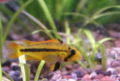
Orange Flash Female
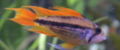
Orange Flash Male

Orange Flash Male
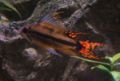
Double Red Male
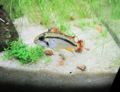
Double Red Male Juvenile
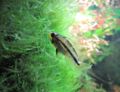
Double Red Female Juvenile


External links[edit]
- Fishbase (Mirrors:
 )
)


