Blood Parrot Cichlid
From The Aquarium Wiki
(Redirected from Blood Parrot)

Blood Parrot Pair
208 Litres (55 US G.)
20.3-25.4cm (8-10 ")
Freshwater
6.0 - 8.0
22 -28 °C (71.6-82.4°F)
8-15 °d
1:1 M:F
10-15 years
Family
Cichlidae
This animal is available captive bred
Contents
Additional names
- Jelly Bean Parrot, Parrot Fish
Origin[edit]
- This is a hybrid fish. Originally believed to be a Severum and Midas Cichlid hybrid, they are in fact the result of breeding Paraneetroplus synspilus with Amphilophus citrinellus. Originally created in Taiwan and further line bred to the fish you see today. A thread on monsterfishkeepers.com showed the progression of a brood of fry obtained by breeding a Redhead Cichlid with a Midas Cichlid. The fry were a combination of traits from the adults, with many of them displaying 'Blood parrot' exaggerated morphology. They have been further linebred into Mammons and King Kong Parrots. Both of these developed strains have more natural morphology. The Kirin parrot is a cross between a Flowerhorn and a Blood Parrot that has been bred to retain the shape of the parrot, but the coloration of the Flowerhorn.
- In recent years there has appeared to be more colors line bred for these fish, as well as an increase in less extreme morphology.
Sexing[edit]
- These fish are not easy to sex, males should have longer and more pointed fins whereas females fins are shorter and more rounded. Males are usually infertile.
Tank compatibility[edit]
- Best kept in species tanks or with other medium sized semi-aggressive/aggressive American Cichlids. Must not be kept with fish small enough to be eaten nor with much larger aggressive fish.
- They are commonly mixed with predators as they are too large to swallow but also not aggressive enough to do any damage.
Diet[edit]
- Not a fussy eater and will take many foods such as Cichlid pellets, daphnia and bloodworms.
Feeding regime[edit]
- Feed once or twice a day.
Environment specifics[edit]
- Appreciate a large tank with wood and rock décor. Will rearrange the tank to suit its needs.
Behaviour[edit]
- Very big personalities, can become aggressive with other fish if laying eggs.
Identification[edit]
- Red-orange in colour, with a short, almost stunted, round laterally compressed body. The mouth on this truly stands out as, because of the hybridisation, it is unable to close it's mouth fully. Due to the hybridisation they also often have other abnormalities such as deformed swimbladders, stunted spines and oddly, exceptionally large irises.
Species Note[edit]
- This fish is also commonly seen as a victim of being a dyed fish. Dyed Blood Parrots are often referred to as Jelly Bean. Their true colour is red to orange, anything other than that, or a red just too vibrant, they've been dyed. They have also been seen being victims of the horrific fad of tattooing fish, and even being mutilated to appear heart shaped by cruelly amputating the tail. More and more of these fish available nowadays have less, and less of said characteristic deformities, appearing more like normal cichlids, to the point that there are even fertile specimens.
Pictures[edit]
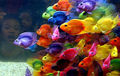
Dyed Parrotfish
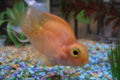
Young Blood Parrot
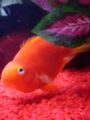
Orange Blood Parrot
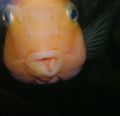
Deformed Mouth
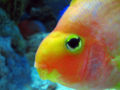
Blood Parrot
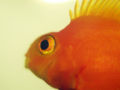
Young Blood Parrot
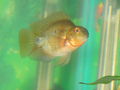
Normal Blood Parrot


