Serpae Tetra (Hyphessobrycon eques)
From The Aquarium Wiki
(Redirected from Callistus Tetra)
Serpae Tetra

Serpae Tetra
Hyphessobrycon eques
57 Litres (15 US G.)
3-4.1cm (1.2-1.6 ")
Freshwater
5.0 - 7.8
22 -26 °C (71.6-78.8°F)
10-25 °d
1:2 M:F
3-5 years
Family
Characidae
This animal is available captive bred
Contents
Additional names
- Serpae Tetra, Jewel Tetra, Callistus Tetra, Blood Characin
Additional scientific names
- Cheirodon eques, Chirodon eques, Hemigrammus melasopterus, Hemigrammus serpae, Hyphessobrycon callistus, Hyphessobrycon serpae, Megalamphodus eques, Tetragonopterus callistus
Origin[edit]
- Found in South America, primarily in Amazon, Guaporé and Paraguay River basins.[1]
Sexing[edit]
- Females are more rounded and robust than the slimmer males.
Tank compatibility[edit]
- Can be nippy amongst themselves and towards other fish, keep in groups of 6 or more. Do not keep with slow moving, long-finned or very small fish. Can be put with other short finned fast swimming fish such as Zebra Danios.
Diet[edit]
- Will take most foods including pellet and flake, as well as live/frozen foods such as brine shrimp and daphnia.
Feeding regime[edit]
- Feed once or twice a day.
Environment specifics[edit]
- Appreciate open swimming space as well as tall plants to hide in. They don't like very strong currents or very bright lights. Sensitive to water parameters, so make sure they have a mature tank and good quality filter.
Behaviour[edit]
- This fish is generally peaceful as long as it's kept in a good group. However, they can get over-excited at feeding time and nip at fins of their own and other species, reminiscent of a Piranha feeding frenzy!
Identification[edit]
- Similar, but slightly more elongated, body shape to the Black Widow Tetra. They are coloured a rich red-brown colour all over. They have a black comma shaped spot behind the gills on either side of the flanks, this spot fades as the fish ages. The caudal, anal and ventral fins are red, whereas the dorsal fin is is tall and black with a white fringe. The anal fin is also fringed with black and white.
- A long-fin variety has been bred, but is prone to being nipped.
Pictures[edit]
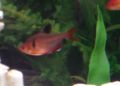
Serpae Tetra
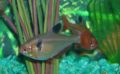
Serpae Tetras
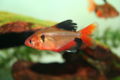
Long-fin Serpae


References[edit]

External links[edit]
- Fishbase (Mirrors:
 )
)


