Clown Loach (Chromobotia macracanthus)
From The Aquarium Wiki
Clown Loach

Clown Loach
Chromobotia macracanthus
284 Litres (75 US G.)
15.2-30.5cm (6-12 ")
Freshwater
6.0 - 7.5
22 -30 °C (71.6-86°F)
5-12 °d
2:3 M:F
20-50 years
Family
Cobitidae
Contents
Additional names
- Tiger Botia, Clown Loach
Additional scientific names
- Botia macrocanthus, Botia macracantha, Cobitis macracanthus
Origin[edit]
- Endemic to Indonesia (Sumatra and Borneo), often found at the bottom of main river channels hiding under rocks, wood or in mud cavities.
Sexing[edit]
- Females may be fatter. A mature clown (5-6" in length) may be sexed by looking at the caudal fin. The upper and lower fin tips on the male are slightly bent inwards, making the fin look a little claw-like.
Breeding[edit]
- There have been several unconfirmed reports of Clown Loaches breeding in captivity. But it appears that this fish may become sexually mature only after many years (though young 2-3 year old females do carry eggs) and the fish has attained a length of at least 15.2-17.8cm (6-7"). Many of these reports stem from the fish being triggered to breed by the injection of hormones and not naturally.
- One report claims in the wild the river water level would drop during a heat wave and there would be lots of dead fish in the water which the clowns eat eagerly. When the rains return the fattened clowns breed.
- Breeding reports : PFK magazine.
- Latest breeding report: Eggs pictures - PFK magazine
Tank compatibility[edit]
- A relatively peaceful fish that must be kept in groups of at least 5-6 of its own kind. Can be quite active and shouldn't be kept with shy or delicate fish. Do not keep with very small fish or fry as they may get eaten.
Diet[edit]
- Will accept most foods including catfish pellets, earthworms, par-boiled vegetables (e.g. cucumber, courgette, lettuce and some will eat things like broccoli, sprouts or peas), any flake that sank, even small snails when the fish gets over 7.6cm (3") in length. They are often sold as a solution to a snail infestation, however, they will not always clear a tank and shouldn't be relied upon to do so.
Feeding regime[edit]
- It's a bottom feeder, so quick sinking food is a must. Feed once or twice a day.
Environment specifics[edit]
- Provide plenty of hiding places, where several can hide together. Clowns, like most Loaches, need to be kept in groups of 5 or more. Since they come from a river environment in the wild, they appreciate some reasonable current within the tank. A long and wide tank is preferred over a tall tank.
Behaviour[edit]
- This fish will fool the new aquarists into thinking it is dead at some point. This active fish loves to hide in small cracks in rocks in the wild and so lacking these in an aquarium tends to play dead. It will just rest in whatever angle it happens to find itself in. So it's fairly common to see it lying on its side, on its head, etc. even with other members of its shoal.
- This fish likes to use its pectoral fins to move about the substrate, almost like it's walking.
- This is a sociable fish which likes the company of its own kind. It prefers a large hiding place where several of them can all hide together in a group.
- To ensure you see them during the day, have in your tank a school of Tetras or similar small schooling fish. This makes the Clowns feel more secure and more likely to venture out during the day.
- The Clown Loach will make clicking sounds when it is feeding on a favourite food.
- Young Clowns love to squeeze into tight areas and also love water flow. Beware of powerhead outlets. There have been young clowns that "disappear" only to be found dead during a filter cleaning.
Identification[edit]
- The Clown Loach in fact has very similar colouration to the Tiger Barb, in that the base colour is a vivid orange over laid by several, usually 3, unbroken thick vertical bands. Young clowns may actively school with the barbs or attempt to interact with them.
- This is a very slow growing fish and should attain around 20.3-30.5cm (8-12"), however, this will only be achieved after many many years and providing the fish is kept in suitable spacious surroundings.
- There are two regional colour variations of this fish, the Borneo and Sumatran. The Borneo fish has more defined sharper black markings and have a black area in the base and center of the pelvic fin, and usually the front (hard) ray is red/orange in color, with the end of the fin being clear, smoky, or slightly red, whilst in Sumatran fish the fin is all red/orange.[1]
Special Considerations[edit]
- This fish is scaleless, therefore it is sensitive to chemicals added to the water. Quite often chemical treatments must be reduced in quantity so as not to stress the Loach.
- The Clown Loach is also more prone to skin damage due to bad water quality and to protozoans attacks such as White Spot.
- This fish species grows very large and this must be taken into consideration before adding them to an aquarium. A tank of over 284 Litres (75 US G.) and at least 6' (1.8m) in length is strongly recommended.
Pictures[edit]
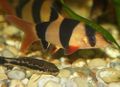
Clown loach & Dwarf Oto
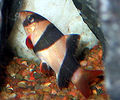
Young Clown Loach
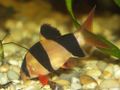
Young Clown Loach
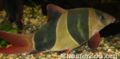
Large Clown Loach (Greying out)


Videos[edit]
| Young Clowns feeding on cucumber: | Note cheek spine: |
Links[edit]
- Fishbase (Mirrors:
 )
)

- Loaches.com
- The Tropical Tank
- Practical Fishkeeping
- Aqua Hobby
- Clown Loach Gallery
- How to Keep Loaches
- Clown Loaches - Profile & Videos
- Clown Loach Article- With Pictures & Diagrams
- Clown Loach by Ola Åhlander - Interesting article worth reading
References[edit]
- ↑ Loaches.com Clown Loach Coloration & Marking Variations


