Red Humped Eartheater (Geophagus steindachneri)
From The Aquarium Wiki
Red Humped Eartheater

Red Humped Eartheater
Geophagus steindachneri
208 Litres (55 US G.)
10.2-15.2cm (4-6 ")
Freshwater
6.0 - 7.5
25 -30 °C (77-86°F)
5-15 °d
1:2 M:F
8-15 years
Family
Cichlidae
Contents
Additional names
- Red Humped Eartheater, Redhump Geophagus
Additional scientific names
- Geophagus hondae, Geophagus magdalenae, Geophagis hendai
Origin[edit]
- Found naturally in the upper Rio Magdalena River and its smaller tributaries in Venezuela and Columbia.
Sexing[edit]
- Male have a large red forehead hump that develops as they mature, and an orange spot in the corner of the mouth and elongated fins.
Breeding[edit]
- Breeding is not difficult and Geophagus steindachneri is sexually mature from 2.8" (7 cm). Geophagus steindachneri is a maternal mouthbrooder, like many of the Cichlids of the African Rift Lakes . The mating rituals can take up to 6 hours, in this time the male will attempt to entice a female by opening his mouth and shaking his jaw at her. The female may lay from 30-150 bright yellow eggs on a previously cleaned stone. The eggs are immediately taken into the female's mouth along with the sperm of a male. The eggs are mouthbrooded for a period of 15-20 days. The female should not be fed during this time, until after the fry become visible, as she may accidentally swallow her brood. The large fry are easy to feed with dry and small live foods.
Tank compatibility[edit]
- Considered to be peaceful to mildly aggressive, they can be kept with other peaceful, non-predatory South and Central American Cichlids of less then 15 cm. Other possible tank mates include medium sized tetra (Silver Dollars, Headstanders…) and Catfish such as Loricarids, Pimelodids, and Doradids.
Diet[edit]
- Good quality flake/pellet food, but the addition of frozen, freeze dried and/or live food should be provided. Mosquito larva, crustaceans, tubifex worms, blood worms, Daphnia, brine shrimp and Cyclops. Being omnivores a balanced diet including vegetables (Corn, Peas, Lima Beans, Carrots, and Zucchini) will help them reach their full potential. In nature they eat all edible stuff that is sifted from the river bottom.
Feeding regime[edit]
- Feed once or twice a day, no more than can be consumed in a few minutes.
Environment specifics[edit]
- Provide with hiding places/caves made from driftwood, rocks and unglazed ceramic pots. In order to give them the best quality of life, and enjoy the fullest display of natural behaviours a deep substrate of sand or fine gravel should be provided. a well-planted tank, made up of well rooted plants should also be provided.
- Not difficult to keep, but are sensitive to water quality issues as with most Cichlids, regular water changes are a must.
Behaviour[edit]
- Typical Cichlid when breeding, males form a harem, and can be territorial. Otherwise a relatively peaceful Cichlid.
Identification[edit]
- The common body colours are red, orange, gold, green and black, which is marked with irregular black spots and the fins are spotted with iridescent scales. (See sexing.)
Pictures[edit]
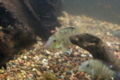
Juvenile Male
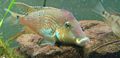
Male


Videos[edit]
External links[edit]
- Fishbase (Mirrors:
 )
)


