Kenyi Cichlid (Pseudotropheus lombardoi)
From The Aquarium Wiki
(Redirected from Kenyi Cichlid)
Kenyi Cichlid

Male Kenyi Cichlid
Pseudotropheus lombardoi
170 Litres (45 US G.)
12.7-15.2cm (5-6 ")
Freshwater
7.5 - 8.3
22.8-27.2°C (73 -81 °F)
12-25 °d
1:3 M:F
8-12 years
Family
Cichlidae
This animal is available captive bred
Contents
Additional names
- Kenyi Cichlid, Kennyi Cichlid, Golden Zebra Cichlid
Additional scientific names
- Maylandia lombardoi, Metriaclima lombardoi, Pseudotropheus liliancinius
Origin[edit]
- The Lombardoi is endemic to the rocky shores of Mbenji Island and Nkhomo reef, located in Lake Malawi in east Africa. It has also been introduced to Namalenje Island.
Sexing[edit]
- The Lombardoi is sexually dimorphic. Females and juvenile males are pale blue with several dark vertical bands extending into the dorsal fin. Adult males turn bright yellow with faint dark bars crossing the body. Adult male fins are plain yellow with egg spots on the anal fin.
- When mouthbrooding, females may assume the colouration of males.
Breeding[edit]
- A single male should be kept with several females. Like most Mbuna Cichlids, this species is a maternal mouthbrooder. When breeding, females hold the eggs and fry in their mouths for a few weeks before releasing the free-swimming fry. When alarmed, the fry regain entry to the female's mouth by direct contact.
Tank compatibility[edit]
- Really aggressive and territorial, only keep with large, robust fish that are large enough to not be bullied and killed by them. Needs large open space with rocks and plants for tank mates.
Diet[edit]
- In the wild, the Lombardoi feeds on loose algae from the rocky surface as well as on plankton in the open water. In the aquarium, the Lombardoi will accept pellet foods such as spirulina.
Feeding regime[edit]
- Feed it small amounts of food several times a day instead of administering a large amount of food on a single occasion in order to avoid polluting the water. Refrain from feeding it protein rich live food such as feeder guppies, blood worms and ghost shrimp. Being largely herbivorous, their digestive system will cease functioning effectively if they are fed excessive amounts of protein.
Environment specifics[edit]
- It needs a spacious well-filtered tank with a rocky set up with secure caves. Some open swimming spaces are needed with a sand or crushed coral substrate.
Behaviour[edit]
- These fish are known to be highly aggressive and territorial, and often injure or kill other fish sharing its tank. Aggressive males exhibit territoriality by digging pits in the gravel or sand, staking its claim and defending it fiercely.
- To prevent casualties, the aquarium should be spacious and rocky with several hiding places. It can be kept with other cichlids of Lake Malawi, preferably other mbuna with the similar level of aggressiveness.
Identification[edit]
- The Lombardoi has a "typical" Mbuna shape. The colouring depends on the age and sex of the fish. Females are pale blue to deep blue with six to eight transverse, black bands. The bands are begin at the crest of the black and fade in colour as they move down towards the belly. The first band runs to the eye and the last is located near the tail. The belly is lighter in colour. The fins are light blue and the caudal fin has some vertical, spotted lines. The dorsal fin has five dark splotches where the longitudinal bands end, and has a black fringe. Males are yellow in colour and may or may not have the transverse bands that the female possesses. The fins match the body colour.
Pictures[edit]
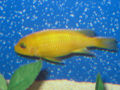
Male
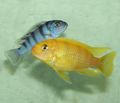
Male & Female


External links[edit]
- Fishbase (Mirrors:
 )
)


