Ocellated Lamprologus (Lamprologus ocellatus)
From The Aquarium Wiki
Ocellated Lamprologus

Young Ocellated Lamprologus
Lamprologus ocellatus
57 Litres (15 US G.)
5-6 cm (2-2.4")
Freshwater
8.0 - 9.0
23 -25 °C (73.4-77°F)
9-19 °d
1:1 M:F
5-8 years
Family
Cichlidae
This animal is available captive bred
 |
You can contribute to the Aquarium Wiki by expanding this article. Dont be shy!. |
Contents
Additional names
- Ocellatus, Ocellated Lamprologus, Gold Ocellatus
Additional scientific names
- Julidochromis ocellatus, Neolamprolagus ocellatus, Lamprologus lestradei
Origin[edit]
- Endemic to Lake Tanganyika.
Sexing[edit]
- Females will reach 3.8cm (1.5") while males can reach up to 5.1cm (2"). Males are also usually more elongated in body than females. The tips of the anal and dorsal fins of females are usually white while those of males are usually gold. Males are more aggressive and will attack anything that invades their territory.
Diet[edit]
- Small crustaceans, insect larvae and plankton, crustaceans being the most preferred. In the aquarium they can be fed brine shrimp or pellets with a good amount of protein.
Environment specifics[edit]
- This is a shell dwelling species and is very serious about it. Naturally occurring in Lake Tanganyika on the coastal regions of the lake where there are many empty Neothauma tanganicensis shells. They will protect, cling to and basically live in their shell of choice. It is good advice to have at least 2 shells per each fish. This is because they do have preferences on which shell they want to inhabit. Once they choose one they will guard it and the area around it without fear.
Behaviour[edit]
- Dwelling in their shell and protecting the area around it this little Cichlid will attack even the largest fish that comes near it. They will take really good care of their 'lawn' and will most likely bury the shell they claim until only the opening is above the sand. They are likely to move any debris that comes within unacceptable range of their house. They like to play in the sand. To dig they put their belly on the surface of the sand and wiggle very quickly spitting up sand everywhere.
- The shell is also the home to their fry and it is very common to never even see the eggs. The fry will dare swim away from the shell eventually when they get older. It has been observed that a female with fry will allow another female to pass through her territory although not without a raised fin as a warning. A male will not let anything get near its territory without attacking it.
Identification[edit]
- If there is a shell around this fish will be in it. They are always under 2 inches in length and tend to stay near the bottom of the tank. Their pectoral fins are more round shaped than many of the other Lamprologus. It almost resembles a clam shell.
Pictures[edit]
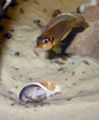
Ocellatus Gold with Fry

External links[edit]
- Fishbase (Mirrors:
 )
)


