Malaysian Trumpet Snail (Melanoides tuberculata)
From The Aquarium Wiki
Malaysian Trumpet Snail

Malaysian Trumpet Snail
Melanoides tuberculata
19 Litres (5 US G.)
1.3-2.5cm (0.5-1 ")
Freshwater
7.0 - 8.0
18 -30 °C (64.4-86°F)
6-15 °d
1-2 years
This animal is available captive bred
Contents
About this snail[edit]
- These are a group of burrowing snails that are commonly found in freshwater aquarium tanks. These popular scavengers provide a useful function of breaking up the substrate therefore reducing anaerobic bacteria and eating decaying plant and dead animals. They also eat algae. They are extremely good cleaning crew for a tank with substrates.
Alternative names[edit]
- Malaysian Trumpet Snail, MTS, Melanoides tubercularia, Trumpet Snail, Malayan Burrowing Snail, Malayan Mud Snail, Red-rimmed Melania, Dominican Trumpet Snail.
Sexing[edit]
- Contrary to common opinion, Malaysian Trumpet snails are NOT hermaphrodite (where each individual has both male and female organs). Malaysian Trumpet snails are gonochoric (either male or female). They cannot change sex, either.
- However, they are also apomictic parthenogenetic (females can produce young female clones without a male to fertilise the eggs). Usually a large proportion of the snails are female clones, commonly the entire population in some areas.[1]
Breeding[edit]
- Produce live young by parthenogenesis.
- MTS will overrun a tank easily if foods are plentiful. Feed sparingly.
Tank compatibility[edit]
- Will mix with virtually any other non-predator aquatic animal. Will generally not be touched by small Loaches or Puffers as their long conical shell is too difficult to get into.
Diet[edit]
- Eats algae, left over fish food, par-boiled vegetables, fruit. Will not eat plants if there is enough other food to eat.
Feeding regime[edit]
- Only supplement food if necessary.
Environment Specifics[edit]
- Must have calcium (hardness) in the water and a pH greater than 7.0 or the shell will dissolve and the snail will die.
- Do not keep it with Puffers or Loaches, as they may try to eat the snail. Some tetras, at least neons, can bite their tentacles (maybe mistaken for worms).
- Remarkably tolerant of salt or Copper, so can be kept in brackish water up to 30ppt. Copper based snail treatments will not kill it.
Behaviour[edit]
- This snail is a slow roamer spending the majority of the time just under the substrate (never more than 0.5") and comes up at night where it will explore all over the aquarium keeping under the water.
- The snail can not control its own internal temperature so if it is kept at the higher temperature, it will move around more quickly, but will have a shorter life span of about a year.
- This snail has gills so it has no need to break the surface to breath air. However if the level of oxygen in the water drops this snail will climb up to just below the surface where oxygen is usually more plentiful.
- These are great indicator snails, if seen above the water line it could mean that there's something wrong with the water.
Identification[edit]
- Conical (cornucopia) in shape with a light coloured shell, usually mature snails have a white tip, with brown dots which line up to become strips as the shell grows.
Special Notes[edit]
- The condition of its shell shows the history of its life. So if purchasing one, look carefully at its shell.
- You should be aware that snails are able to carry various parasitic flukes, which can be transmitted to fish, or humans. Most of these flukes require intermediate hosts, so that leaving the snails by themselves for a month or so will eliminate the fluke.
- Reputed to be extremely copper resistant.[2]
- The presence of this snail in the substrate can be so discomforting for fish such as the weather loach which sift the substrate through their gills whilst searching for food and/or which burrow through or bury themselves in the substrate, that they then avoid these normal behaviours. Thus the snail could be a contributory stress factor for such fish.
Removing Trumpet Snails[edit]
- Some aquarists do not like these snails due to their ability to multiply rapidly. There are several methods of removing snails:
1.Adding a chemical into the water that kills them.
- There are a range of commercial liquids available which claim to kill snails. Be careful reading the products as most just stun them or cause them to come to the surface for a time. Copper may only stun them.
2.Adding a chemical into the water that stuns them.
- There are a range of commercial liquids available which claim to stun snails. Be careful as a lot of dead snails in your tank will lead to dangerous ammonia production as the flesh decays.
3.Manually removing the snails.
- Simply remove the young snails as they approach the surface when feeding at night. Alternatively remove the snails that are on the glass with your fingers.
4.Baiting a trap and removing them.
- There are several commercial snail traps available. These you bait at night and the snails crawl in and can't get out. So in the morning you simply remove the trap. Simple to make your own too. See JBL Snail Trap Review.
- You can create a homemade trap by simply dangling a slice of cucumber in the water with some fishing line. After the snails have attached themselves to the cucumber, you can extract the slice and remove the sails.
5.Add an animal that will eat them.
- Most loaches will eat these snails. Whilst the Clown Loach is the most often quoted as doing this function it can grow quite large. If you want a smaller fish there are several species of loaches (like the Zebra Loach, Pakistan loach (Yo Yo)) that remain under 4" in length and will eat the snails when small. Puffers like the Ceylon Puffer will eat any type of snail once it grows bigger enough.
- Anentome helena, the Assassin snail will eat them.
6.Reduce the oxygen content in the water.
- Seal top or add sugar (1 tsp per 25 Litres (6.6US G.) and wait two days) and they will rise to the surface. Obviously do not do this when you have other animals in the tank! May affect the nitrifying bacteria in the filter.
(this area needs expanding)
Preventing Snails from entering your tank[edit]
- You need to soak all objects and plants with a snail killing chemical before adding to your tank. One such popular and cheap chemical for doing this is Potassium Permanganate.
Pictures[edit]
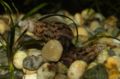
Two Trumpet snails
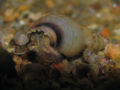
Trumpet Snail


References[edit]
- ↑ http://www.academia.edu/2779522/Melanoides_tuberculata_The_history_of_an_invader Academia.edu - The History of an Invader
- ↑ PFK Issue 7/July 2008, page 22, Jason Scott
External links[edit]
- WindyCityAquariums.com - USA Seller
- AquaHobby
- Snail Shop UK
- Robyn's Snail and Clam Page
- Wikipedia
- Melanoïdes tuberculata
- Fact sheet for Melanoides tuberculata (Müller, 1774)
- Buy Trumpet Snails
- Tropical Fish Magazine article 'Taming the Tenacious Trumpet Snail' by Tom Lorenz. August 2009 (requires free registration)
- An identification manual for the freshwater snails of Florida


