Multies (Neolamprologus multifasciatus)
From The Aquarium Wiki
(Redirected from Multifasciatus Dwarf Cichlid)

Neolamprologus multifasciatus
11 Litres (3 US G.)
3-4 cm (1.2-1.6")
Freshwater
7.8 - 8.5
24 -28 °C (75.2-82.4°F)
12-20 °d
1:2-4 M:F
5-8 years
Family
Cichlidae
This animal is available captive bred
Contents
Origin[edit]
- Endemic to Lake Tanganyika, where it lives in open sandy areas with large quantities of Neothuma snail shells. The cichlids use these snail shells as shelter.
Sexing[edit]
- Difficult, but mature males are larger than females. Females are less than 3 cm in total length. Males are also noticeably more aggressive.
Tank compatibility[edit]
- Will get along with most fish that are not bottom-dwellers and which will not eat them, unless the tank is the minimum 10-15 gallon tank. Do not expect them to get along with other shell dweller species unless the tank is very large. One could venture to keep these in a 30 gallon tank with some julidochromis or chalinochromis species, but err on the side of caution. If there is not a definite line between the rockwork and shell beds (ideally leave a margin of 15 centimetres), there will be inevitable disputes, leading to the death of many Multies.
Diet[edit]
- Carnivores that will eat most food available. Feeding live and frozen foods is an extremely reliable way to get these fish to spawn.
Feeding regime[edit]
- The usual once or twice a day feeding regime will work.
Environment specifics[edit]
- A harem of one male and three or four females will work well in a 3 gallon tank, but a much larger tank is needed if multiple males are to be kept. The tank should have at least 3 inches of sand and at least 2 shells for every cichlid: the shells should be fairly large, such as escargot shells. Ideally use genuine neothauma shells (although these can be expensive). This fish does not take nitrates very well, and two 25% water changes a week are a good idea with any Tanganyikan cichlid.
Behaviour[edit]
- Lives and breeds in snail shells. The fish will move these snail shells to their liking and will do a great deal of digging to accomplish this, so rooted plants may not be the best idea unless they are potted.
Identification[edit]
- Very small cichlids which live in snail shells. They can easily be confused with neolamprologus similis, but can be distinguished by using their stripes - similis looks like it has light stripes on a dark body, while multifasciatus appears to have dark stripes on a light body. Similis will also not live as a harem in a 3 gallon and need to kept as pairs in such small tanks, so being able to tell the difference is important.
Pictures[edit]
Multi
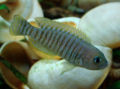
Multi Male


Videos[edit]
| Adults and shells: | Adults with fry: |
| Adults making a nest |
External links[edit]
- Fishbase (Mirrors:
 )
)


