Panda Dwarf Cichlid (Apistogramma nijsseni)
From The Aquarium Wiki
(Redirected from Panda Dwarf Cichlid)
Panda Dwarf Cichlid
.jpg)
Male Panda Dwarf Cichlid
Apistogramma nijsseni
57 Litres (15 US G.)
5.1-7.1cm (2-2.8 ")
Freshwater
5.0 - 6.5
23 -30 °C (73.4-86°F)
1-5 °d
1:3 M:F
3-5 years
Family
Cichlidae
This animal is available captive bred
Contents
Sexing[edit]
- The males are larger and have greyish blue coloured body with red edged tail. The females are smaller with yellow body with black spots and red edged tail.
Breeding[edit]
- Panda Dwarf Cichlids are cave breeders that are best bred in a pH of 5.5, at higher pH's eggs are unlikely to hatch and there will be a low survival rate. It is said that warmer temperatures over 26°C (78.8°F) will give more males than females. They make excellent parents towards their eggs and fry.
Tank compatibility[edit]
- These Dwarf Cichlids are best kept in either a male/female pair or one male with several females. More than one male may fight over territory. They are generally peaceful towards other tank mates, although very small fish and other species fry are likely to be eaten. Do not keep with very boisterous fish nor with fin-nippers.
Diet[edit]
- This fish may have dry food (flakes or pellets), although it prefers frozen food (like brine shrimp or bloodworms) and live food (daphnia, insect worms, Grindal worms).
Feeding regime[edit]
- Feed once or twice a day.
Environment specifics[edit]
- In order to mimic the natural environment, the tank should be planted and furnished with plenty of bogwood and/or rocks with many hiding places. Dark sand or gravel could be used as substrate. Leaf litter is advisable. Dim lighting and/or floating plants (Pistia stratioides, Salvinia natans, Limnobium laevigatum).
Behaviour[edit]
- Males will be territorial towards other males. They are primarily bottom dwellers.
Identification[edit]
- See sexing.
Pictures[edit]
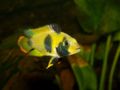
Female
.JPG)
Videos[edit]
| Mother with fry: |
External links[edit]
- Fishbase (Mirrors:
 )
)

- Cichlid-Forum - Spawning Apistogramma nijsseni
- Aqua Articles - Breeding Apistogramma nijsseni
- The Tropical Tank
- Aquatic Community


