Electric Yellow Cichlid (Labidochromis caeruleus)
From The Aquarium Wiki
(Redirected from Yellow Lab)
Electric Yellow Cichlid

Electric Yellow Cichlid
Labidochromis caeruleus
95 Litres (25 US G.)
10-13 cm (3.9-5.1")
Freshwater
7.5 - 8.6
22 -28 °C (71.6-82.4°F)
10-15 °d
1:3 M:F
6-8 years
Family
Cichlidae
This animal is available captive bred
Contents
Additional names
- Electric Yellow Cichlid, Yellow Lab, Electric Yellow Lab
Additional scientific names
- Labidochromis caeruleum
Origin[edit]
- Although the yellow morph is reported to be rare in the wild, it is common in the aquarium trade. They are reported only from deep water, rocky habitats on the north end of Lake Malawi.
Sexing[edit]
- In general dominant males will show more black in the fins and a more pronounced forehead, like many Mbuna, Labs are a good candidate for venting. Like other African Cichlids, males commonly (but not always) have egg spots, small, typically white-yellow circles on the anal fin.
Breeding[edit]
- Typical Cichlid Mouthbrooder. While breeding, the pair will become very territorial, often chasing other fish away from their breeding zones. It is recommended to place the female in her own recovery tank for several weeks. While the eggs are in her mouth, otherwise known as "holding," she does not eat and becomes weak. Holding typically lasts somewhere between 3-4 weeks, given that a temperature of 27°-28°C (about 81°-82°F) is maintained. Alternatively, the female can be stripped, where the fry, which hatch (but stay in the female's mouth) after 10-15 days, are externally forced outwards. This method is typically done for controlled 'birth,' so that the cichlid fry can be released in a controlled environment.
Tank compatibility[edit]
- The Yellow Lab should be considered semi-aggressive in a normal tank, and should not be housed with other non-African Cichlid tankmates. Yellow Labs are best kept with other semi-aggressive Cichlids from Lake Malawi and are generally peaceful to other types of African Cichlids and can be territorial towards others of their own species.
Diet[edit]
- In the wild their diet consists mainly of small invertebrates, but being an omnivore the Electric Yellow Cichlid does well on a predominantly herbivore diet, but benefits from added protein more than the average mbuna.
- High protein food sources have been reported to cause Malawi Bloat.
- Feeding suggestions include Brine Shrimp, Krill, Spirulina, Flake Foods, Pellet Foods, and vegetables such as peas and cucumbers.
Feeding regime[edit]
- Feed once or twice a day.
Environment specifics[edit]
- Because the Electric Yellow lab is a type of Mbuna, it prefers a tank with lots of rocks and caves and are well suited to sand as a substrate. Thrives in high pH and hard water conditions. It may well shred any live plants that it is placed in with.
Behaviour[edit]
- Generally mildy aggressive in an African Cichlid set up, with low potential for territoriality. Adult Yellow Labs may exhibit dominance-related semi-aggressive behaviour with others of their own species. The Yellow Lab may be bullied by more aggressive Mbuna Cichlids.
Identification[edit]
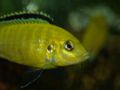
- Bright yellow with black, can be variations, sometimes black under shadows on lower body. A stressed yellow lab may temporarily display faint vertical barring.
Pictures[edit]
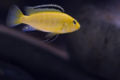
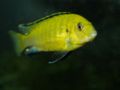
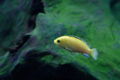
Juvenile Yellow Lab
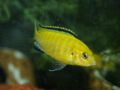
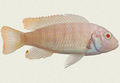
Albino


External links[edit]
- Fishbase (Mirrors:
 )
)


